
For an overview of how this ride compares with other local ascents, explore our best road cycling climbs on the Costa Blanca guide, then use the 7-day cycling itinerary to fit it into your week.
Ask visiting cyclists which climb they most want to ride on the Costa Blanca and Coll de Rates is usually near the top of the list. It deserves its reputation, but the quieter road towards the Sierra de Bèrnia adds another side to the experience. Combine the two and you get a full day of steady climbing, rural villages, changing landscapes and wide Mediterranean views.
Leaving the coast behind
One of the great pleasures of cycling around Jávea and the northern Costa Blanca is how quickly the landscape changes. Near the sea, the roads pass through coastal towns, holiday villas and familiar Mediterranean scenery. Turn inland and the traffic begins to thin, the mountains appear closer and the route enters a landscape of terraced fields, almond trees, orange groves and vineyards.
The Vall de Pop sits at the heart of this ride. Villages such as Xaló, Alcalalí and Parcent still feel closely connected to the agricultural traditions of the valley. Cycling tourism is now an important part of the local economy, but the area has not lost its identity. You are riding through working villages, past family farms and along roads that have linked these communities for generations.
That local character matters. Coll de Rates and Bèrnia are memorable not simply because of their gradients, but because of everything around them: the quiet lanes between the climbs, the changing smell of pine and citrus, the pale limestone ridges and the cafés where riders gather before heading back into the mountains.
Coll de Rates from Parcent
The classic ascent begins near Parcent and follows the road towards Tàrbena. Exact figures vary slightly depending on where a GPS device starts and stops recording, but the recognised climb is roughly 6.5 kilometres long, gains about 350 metres and averages close to 5%. The pass sits at around 625 metres above sea level.
On paper, those numbers do not look intimidating. That is exactly why the climb appeals to such a wide range of riders. It is demanding enough to feel like a proper mountain ascent, but it rarely forces you into a fight with the bike. With sensible gearing, most reasonably fit road cyclists can find a rhythm and enjoy the road rather than merely survive it.
The opening section is gentle and this is where many riders make their first mistake. The legs are fresh, the gradient feels comfortable and there is often another cyclist just ahead who looks tempting to chase. The better approach is to stay patient. Use the first kilometre to settle into a natural cadence and allow your breathing to find the right level.
As the road rises, the bends begin to reveal wider views across the valley. In spring, the slopes can appear surprisingly green. Later in the year, the same landscape becomes drier and more rugged, with the grey mountain rock standing out against the deep blue sky.
Why Coll de Rates feels so good to climb
The middle of Coll de Rates is beautifully consistent. There are enough bends to keep the road interesting, but the gradient rarely destroys the rhythm. This makes it a favourite with professional riders, training groups and cyclists who want a reliable benchmark effort.
You can ride it in several ways. A strong rider may use the climb for a sustained threshold effort. A group on holiday may keep the pace conversational and regroup at the top. Others return several times during a training week to compare pacing, heart rate or power. None of these approaches is more authentic than another. The climb works because it gives every rider space to make the experience their own.
The upper section feels slightly more serious. The road becomes more exposed and there are shorter stretches where the gradient rises towards 7 or 8%. They are not especially long, but they arrive late enough to punish anyone who attacked the opening kilometres. Riders who have kept something in reserve can lift the pace here; those who started too hard may suddenly find themselves searching for another gear.
Near the top, the familiar Coll de Rates sign appears. It has become one of the most photographed cycling landmarks in the area. The pass is not high by Alpine standards, but the sense of arrival is still satisfying. Below, the Vall de Pop opens towards the coast, while the road continues towards the rougher mountain landscape around Tàrbena.
Fast, flowing and worth respecting
The descent towards Parcent is one of the most enjoyable parts of the ride. The road surface is generally smooth and the corners are easy to read, which can quickly build confidence. That confidence should not become carelessness.
Coll de Rates is popular with cyclists, cars and motorcycles. Speed should be controlled before each bend, not halfway through it, and there is never a good reason to cross the centre line. After rain, dust and small stones may collect near the road edge. On cooler winter mornings, shaded sections can remain damp even when the open road is dry.
The road from Xaló towards Bèrnia
After Coll de Rates, the route changes character. The famous climb is often busy with cyclists; the roads towards the Sierra de Bèrnia usually feel quieter and more rural. From the area around Xaló, the road gradually leaves the vineyards and cultivated terraces behind and moves towards the rocky ridge.
Depending on the precise start and finish, the climb is roughly 10 to 12 kilometres long with around 430 metres of elevation gain. The average gradient is modest, generally between 3.5 and 4.5%, but that figure hides the real character of the road.
Bèrnia is not one uninterrupted slope. Easier stretches are followed by short ramps that require an early shift and a controlled response. The changes in gradient make it harder to hold one perfect cadence, but they also make the climb feel more exploratory. It is a road to read rather than a number to chase.
A climb that rewards patience
The lower part of the route passes through the countryside around Xaló. At first, the gradient is so gentle that it is easy to wonder whether the real climb has begun. That can encourage riders to push too hard, particularly after a café stop or an easy section through the valley.
The road gradually becomes more demanding as it approaches the mountain. Rather than holding one constant effort, you need to respond to the terrain. A short steeper ramp may be followed by a flatter section where you can recover without completely losing momentum.
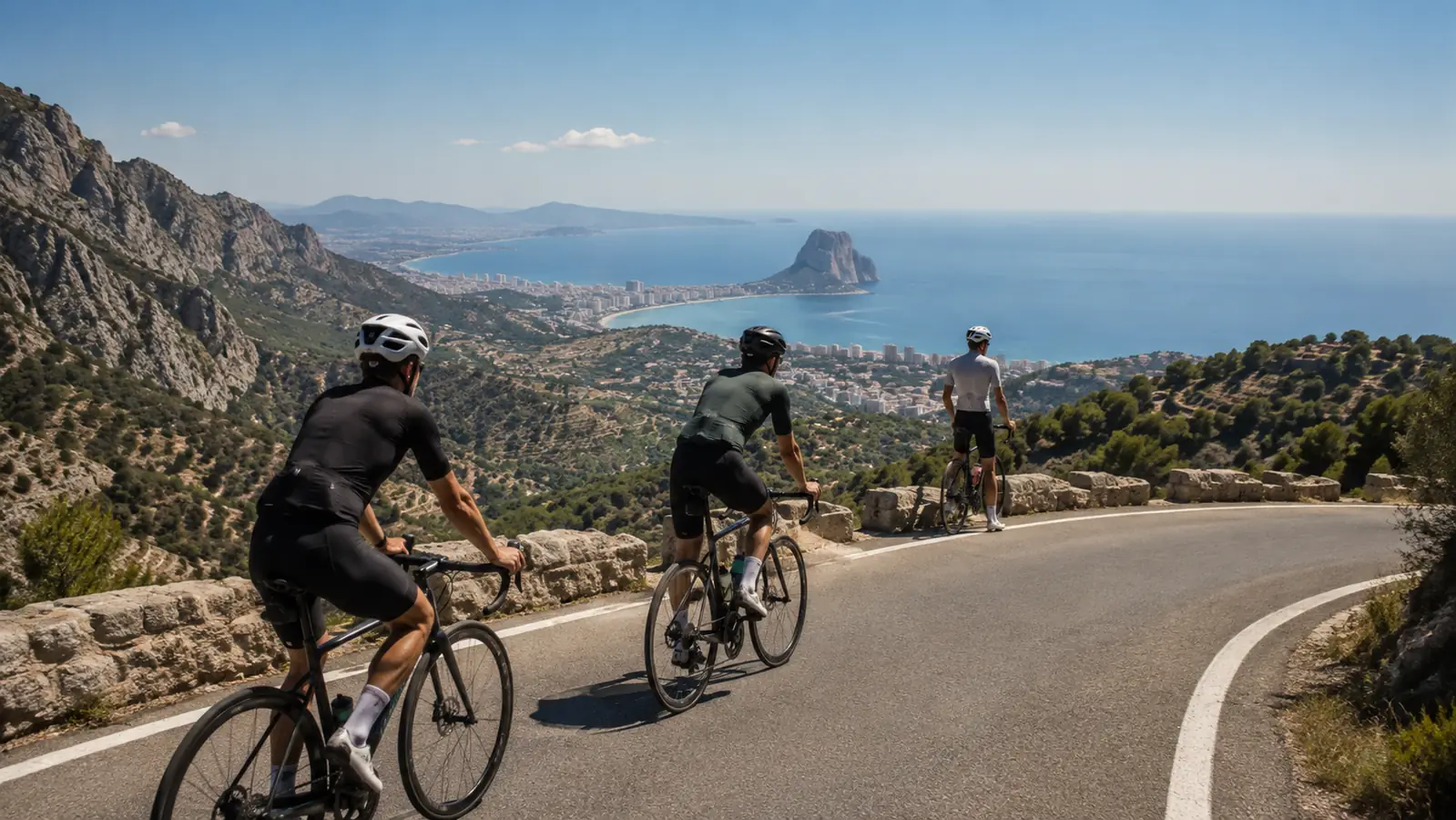
As altitude increases, vineyards and fruit trees give way to pine forest, rocky slopes and broader views. The Sierra de Bèrnia rises sharply above the road and creates a surprisingly remote atmosphere for a mountain so close to the coast. At selected viewpoints, the landscape opens towards Calpe, the Mediterranean and the unmistakable profile of the Peñón de Ifach.
This is where the climb feels most rewarding. It is not only about reaching a summit or collecting another segment. The road appears to move through several landscapes in a relatively short distance, and there are moments when the coastal towns feel much farther away than they really are.
Patience is the best strategy. On Coll de Rates, it is possible to choose a gear and hold a rhythm for much of the ascent. Bèrnia keeps asking smaller questions. Do you push over the next ramp or shift down early? Do you recover on the flatter section or maintain pressure? On a long day, the sensible answer is usually the one that leaves something in the legs for the road home.
Not every Bèrnia route is the same
When looking at routes online, it is important to understand that the name Bèrnia can refer to several different roads. The approach from Xaló is the most suitable option for a classic road-cycling day combined with Coll de Rates. It is scenic, varied and challenging without being extreme.
The Pinos side is more irregular. Its overall average gradient can look moderate, but individual ramps are considerably steeper and the surface may feel rougher. There is also an extreme climb often known as Bèrnia Bis from the Altea la Vella side. That road contains gradients above 20% and is a specialist challenge rather than a normal extension of this route.
A route can look simple on a map while feeling completely different on the bike. The choice of direction, road surface, weather and the ability of the group all matter. This is where local route planning becomes more valuable than simply following the most popular GPS file.
How difficult is the Coll de Rates and Bèrnia ride?
The answer depends on where you begin. Starting near Xaló or Parcent creates a compact mountain ride. Leaving from Jávea, Calpe, Benissa or another coastal base adds distance and more rolling terrain before and after the headline climbs.
For many visitors, a complete loop will fall somewhere between 80 and 120 kilometres, with total climbing that can easily exceed 1,500 metres. The individual ascents are not extreme, but the accumulated effort matters. Heat, wind and the distance back towards the coast can make the final hour much harder than expected.
A compact 50/34 chainset with an 11-30, 11-32 or 11-34 cassette is a practical setup for most recreational riders. Stronger cyclists may prefer tighter gearing, but an easier sprocket gives you more options on the irregular Bèrnia ramps and helps protect the legs over a long day.
Modern 28 mm road tyres are a good choice for comfort and grip. Carry two bottles, basic repair equipment and a lightweight windproof layer for the descents. Even on a warm day near the coast, the combination of sweat, shade and speed can make the mountain roads feel unexpectedly cool.
Food, water and the best time to ride
There are cafés and shops in several valley villages, but it is unwise to depend on finding something open at the exact moment you need it. Carry enough food to start eating early. A small snack before the first climb is far more useful than waiting until energy levels fall sharply.
In warm weather, two bottles should be considered the minimum. The inland valleys can feel hotter than the coast, especially when there is little wind on the lower slopes. Xaló and Parcent make natural coffee stops, although a long break before the second climb can leave the legs feeling surprisingly heavy when the road turns upwards again.
Winter is popular with visiting teams because daytime temperatures are often comfortable, although mornings and descents can be cool. Spring brings greener scenery and longer days. Summer rides should begin early to avoid the strongest heat, while autumn often provides warm conditions, clearer roads and excellent visibility.
Two climbs, two sides of the Costa Blanca
Coll de Rates offers the classic experience: smooth tarmac, a steady gradient, sweeping valley views and the feeling of riding a road shared by professional teams and cyclists from around the world.
Bèrnia adds something different. It is quieter, more varied and slightly more adventurous. The road moves from cultivated countryside into pine forest and rugged limestone scenery before revealing long views towards the Mediterranean.
Together, the climbs show why road cycling here is about far more than warm weather. One ascent is polished and iconic; the other feels rural and unpredictable. The villages, connecting roads, café stops and changing landscape are what turn two well-known names into a complete day on the bike.
At Never Just a Ride, we do not believe the best cycling days come from connecting famous segments as quickly as possible. The direction of travel, the pace of the group, the weather and the right moment to stop all shape the experience. Coll de Rates and Bèrnia can be ridden as a hard training day or as a relaxed exploration of the Vall de Pop. Both versions are worthwhile.
The important thing is to leave enough energy to look up from the handlebars, because on this route the landscape is every bit as memorable as the climbing.
Coll de Rates and Bèrnia FAQ
Can an intermediate cyclist ride both climbs?
Yes, provided the overall route matches the rider’s normal distance and climbing experience. Neither standard ascent is exceptionally steep, but the complete day can be long and should be paced sensibly.
Which climb should come first?
That depends on the start point, wind and group level. Coll de Rates is often ridden first because its steady gradient makes it easier to control the early effort, but a local route can be designed in either direction.
Is the Bèrnia road the same as Bèrnia Bis?
No. The standard road from the Xaló side is a manageable, varied mountain climb. Bèrnia Bis is an extreme ascent with gradients above 20% and is suitable only for highly experienced riders.
Can the route be guided from Jávea?
Yes. Never Just a Ride can build the climbs into a guided ride or a wider road-cycling holiday, with the distance and pace adapted to the group.